
Root canal retreatment in Chinchwad with CBCT, microscope and rubber dam. See the 7 proven steps we follow to save a failed root canal tooth.
Your root canal was supposed to end the problem. Instead, the tooth hurts again, the gum is swollen, or a small pimple keeps coming and going. Maybe someone has already told you the tooth should come out.
Wait before you agree to that. Many of these teeth can still be saved, and that’s exactly what root canal retreatment in Chinchwad is for.
At Joglekar’s Dental Solutions, we do root canal retreatment in Chinchwad with an in-house CBCT scanner, a dental operating microscope, ultrasonic instruments and a rubber dam on every case. This guide walks you through the seven steps we follow, and it’s honest about what retreatment can and can’t promise.
The 7 steps at a glance
- Study the failed root canal on a CBCT scan
- Understand your options: non-surgical or surgical retreatment
- Have an honest talk about time, healing and the chance of surgery later
- Isolate the tooth with a rubber dam
- First appointment: evaluation and slow, detailed cleaning under the microscope
- Let the tooth heal for one to two weeks
- Second appointment: fill the cleaned canals
What is root canal retreatment?
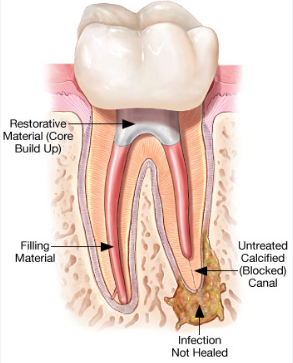
Root canal retreatment means reopening a tooth that already had a root canal, taking out the old filling material, cleaning the canals again and sealing them properly. Think of the first root canal as a job that didn’t hold. Retreatment goes back, finds out why, and does it again with better tools and more time. The old material has to come out first, and the canals are often harder to work in than they were the first time. That’s why root canal retreatment in Chinchwad needs more time, better magnification and a slower pace than a first root canal.
Signs your root canal has failed
The signs are usually easy to spot. You may feel pain when you bite, tenderness when you press on the tooth, swelling in the gum or face, a pimple on the gum that drains, or a bad taste in your mouth. Some teeth give no warning at all, and the problem only shows up on a scan as a dark area around the root tip. If any of this sounds familiar, get the tooth checked before the infection gets worse.
Why do root canals fail?
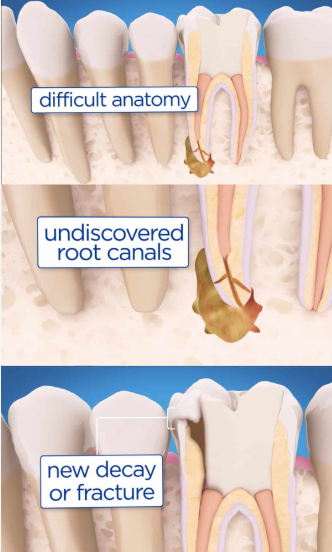
A root canal can fail for several reasons. Many teeth have extra canals, and a missed canal keeps harboring bacteria. New decay can form under an old filling or crown. A crown or filling that leaks lets bacteria back in. Sometimes the canal wasn’t cleaned or sealed to its full length, or an instrument broke inside it. Whatever the reason, we need to see it clearly before we plan root canal retreatment in Chinchwad for your tooth, because the cause decides the treatment.
Step 1: Start with a CBCT scan of the failed root canal
Everything begins with CBCT analysis of the failed root canal. A normal dental X-ray squashes a three-dimensional tooth into a flat picture, so a lot stays hidden. Our in-house CBCT shows the tooth and the bone around it in 3D. We can check whether there’s an untreated canal, how well the old filling reaches the root tip, how big the infection is, and whether there’s a perforation or a broken instrument. With this information, root canal retreatment in Chinchwad becomes a planned procedure instead of a guess.
Step 2: Understand your two options
Once we’ve studied the scan, we explain the possibilities in plain words.
Non-surgical retreatment means we go back in through the top of the tooth, remove the old filling, clean the canals and seal them again. It’s usually the first choice when we can reach the canals.
Surgical retreatment means the root tip is treated through a small procedure in the gum and bone. We consider it when the problem can’t be solved from inside the tooth, or when the infection stays even after good non-surgical treatment.
We don’t push you toward either one. We show you the scan and explain which one fits your tooth.
Step 3: An honest talk before we begin
Before we take up any case, we explain three things clearly. First, retreatment takes time and can’t be rushed. Second, healing is unpredictable, because every tooth and every infection behaves differently, so we can’t promise a guaranteed result. Third, surgery may still be needed later, even after a careful non-surgical retreatment.
If you understand this and you agree, then we take up the case for retreatment. Patients who start with honest expectations make better decisions and feel better about the result. Good root canal retreatment in Chinchwad starts with this conversation, long before any instrument touches the tooth.
Step 4: Rubber dam isolation on every case
We place a rubber dam on every root canal case, including every retreatment, without exception. It keeps saliva and its bacteria out of the tooth, and it protects you from the irrigating solutions we use. A clean, dry working field matters even more in retreatment, because the tooth has already been infected once. When you’re comparing clinics for root canal retreatment in Chinchwad, it’s a fair question to ask whether a rubber dam is used every time.
Step 5: First appointment, evaluation and slow, detailed cleaning
The first appointment is an evaluation appointment, and it’s longer than most people expect. We don’t try to finish the root canal on the same day. Here’s what happens, in order.
We remove the old crown, if there is one. Then we remove the old fillings and any secondary decay underneath, until we have a clean, sound tooth to work on. Next we reach the base of the pulp chamber, which is where the canal openings sit.
Now the slow part begins. Using the microscope and ultrasonics, we carefully remove the old root canal filling material and look for any extra canals that were missed earlier. We clean these canals thoroughly, then place a medicated dressing inside the tooth and seal it.
Why the microscope and ultrasonics matter
Old filling material is dense, and a hidden canal can be thinner than a hair. You can’t do this work well by feel. The dental operating microscope gives us strong magnification and bright light inside the tooth. Ultrasonic instruments let us remove old material and clean tight areas with control, without cutting away more tooth than needed. This slow, detailed work is the heart of root canal retreatment in Chinchwad at our clinic, and it’s the part of the procedure we refuse to rush.
Step 6: Give the tooth one to two weeks to heal
After the first appointment, we give the tooth a week or two to settle. This pause matters. The dressing does its work inside the canals while the tissue around the tooth calms down. When you come back, we check how the tooth is responding. If it’s healing well, we move ahead. If it isn’t, we tell you honestly and talk about what comes next, which may include the surgical option from Step 2. Waiting is a normal and important part of root canal retreatment in Chinchwad, not a delay.
Step 7: Second appointment, filling the cleaned canals
If the tooth has healed properly, the second appointment is for filling the cleaned root canals. We seal them carefully so bacteria can’t find a way back in. After this, the tooth needs a good crown or restoration to protect it, and we plan that with you. That’s the complete path of root canal retreatment in Chinchwad as we do it: scan, plan, clean slowly, heal, then seal.
Caring for your tooth after retreatment
Once the canals are sealed and the crown is done, the tooth needs the same care as any other. Brush twice a day, clean between your teeth, and come for regular checkups so we can follow the tooth over time. If pain, swelling or a pimple on the gum ever comes back, don’t wait. An early review makes the next decision easier.
Retreatment or extraction? How to think about it
Extraction isn’t always the wrong answer. Some teeth are cracked, have lost too much bone, or have too little healthy structure left, and saving them may not be sensible. But a tooth that can be restored is usually worth a serious try. An implant or a bridge is a good option when a tooth can’t be saved, yet it’s a bigger step with its own cost, time and care. We go through all of this with you, using your own scan, so the decision is yours and it’s an informed one.
Why choose us for root canal retreatment in Chinchwad?
Here’s what you get when you come to us:
- In-house CBCT, so planning starts with a 3D view
- A dental operating microscope for detailed work
- Ultrasonic cleaning and old filling removal
- A rubber dam on every case
- A clear, honest discussion before any treatment begins
Dr. Mandar Joglekar has over 25 years of experience, with a focus on advanced restorative and endodontic dentistry. If you’re searching for root canal retreatment in Chinchwad, the process above is the one we follow every time.
Frequently asked questions
Is root canal retreatment in Chinchwad painful? We do the procedure under local anesthesia, so you shouldn’t feel pain during treatment. Some soreness for a day or two afterward can happen, and we’ll tell you how to manage it.
How many visits does retreatment need? At least two, with one to two weeks of healing in between. Complex teeth may need more.
Can every failed root canal be retreated? No. Some teeth have cracks, severe bone loss or too little healthy structure. That’s why we begin with CBCT, so we can tell you honestly whether the tooth is worth saving.
Is retreatment better than extraction and an implant? Often, saving your own tooth is worth trying when it can be restored. It depends on the tooth, and we go through both options with you using your scan.
How long does a retreated tooth last? It depends on the tooth, the infection, the final crown and your oral care. We cannot give a fixed number, and we’d be wary of anyone who does.
Do I need a crown after root canal retreatment in Chinchwad? In most cases, yes. A root canal tooth is more fragile, and a good crown protects the work.
Book an evaluation for root canal retreatment in Chinchwad
If you’ve been told your root canal has failed, or you’re still in pain after treatment elsewhere, don’t rush into extraction. Get a proper evaluation with a CBCT scan first.
Joglekar’s Dental Solutions, Chinchwad, Pune [Book an appointment]
Dr. Mandar Joglekar, dentist with 25 years of experience, specializing in advanced restorative and endodontic dentistry.