
The best dental implant for busy corporate employees in 2027 is a carefully planned, long-lasting tooth replacement that restores comfortable chewing and a natural-looking smile while fitting realistically into a demanding professional schedule.
Why Busy Professionals Need a Different Approach to Dental Implants
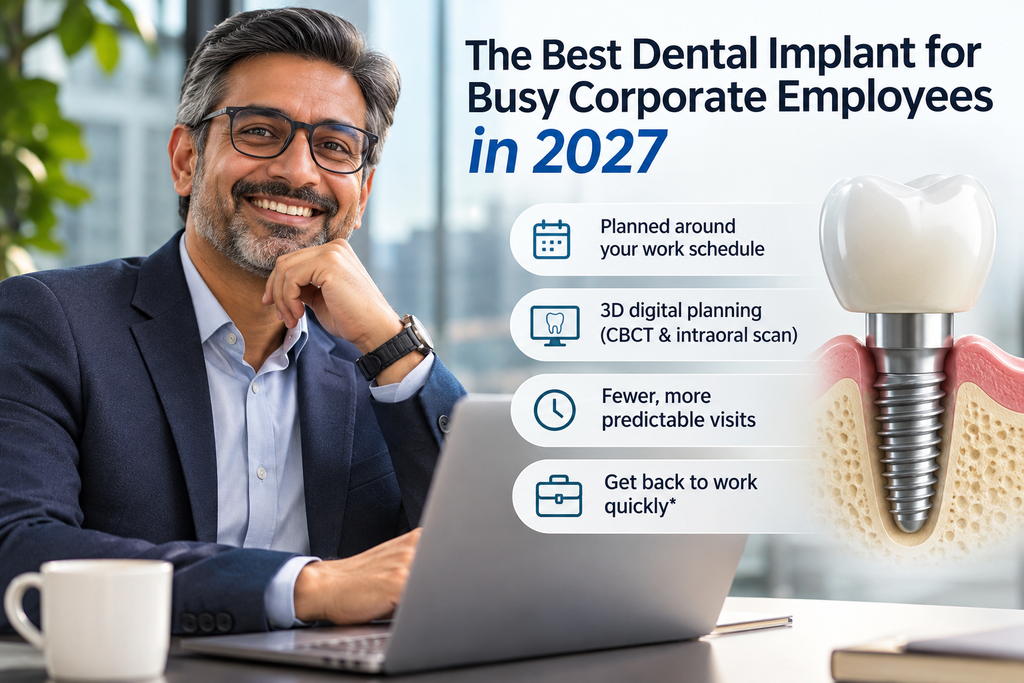
Imagine you’re a 45-year-old IT professional working in Hinjewadi, Pune. Your day begins with an early meeting, continues with client calls, and often ends with unfinished work.
You have a missing molar that’s been bothering you for months.
You know it needs attention, but scheduling multiple dental appointments seems difficult. You’re worried about pain, recovery time, treatment costs and whether dental surgery will interfere with your work.
This is a familiar situation for many professionals living in Chinchwad, Wakad, Pimpri, Akurdi and other parts of PCMC.
Choosing a dental implant for busy corporate employees involves more than finding a replacement for a missing tooth. It means understanding how treatment can be planned around professional responsibilities without compromising clinical safety.
The good news is that modern implant dentistry offers several treatment approaches suited to different clinical situations.
However, there isn’t one implant system or technique that’s best for everyone.
A dental implant for busy corporate employees should be selected according to bone availability, gum health, general medical condition, bite forces, aesthetic expectations and the number of missing teeth.
Let’s explore what professionals should know before choosing implant treatment in 2027.
What’s Changing in Dental Implant Treatment in 2027?
Dental implant technology has evolved considerably over the past two decades.
The important development isn’t simply that implants can sometimes be placed faster. It’s that dentists have better tools for examining, planning and restoring missing teeth.
For someone considering a dental implant for busy corporate employees, these advances can make the treatment process easier to understand and organize.
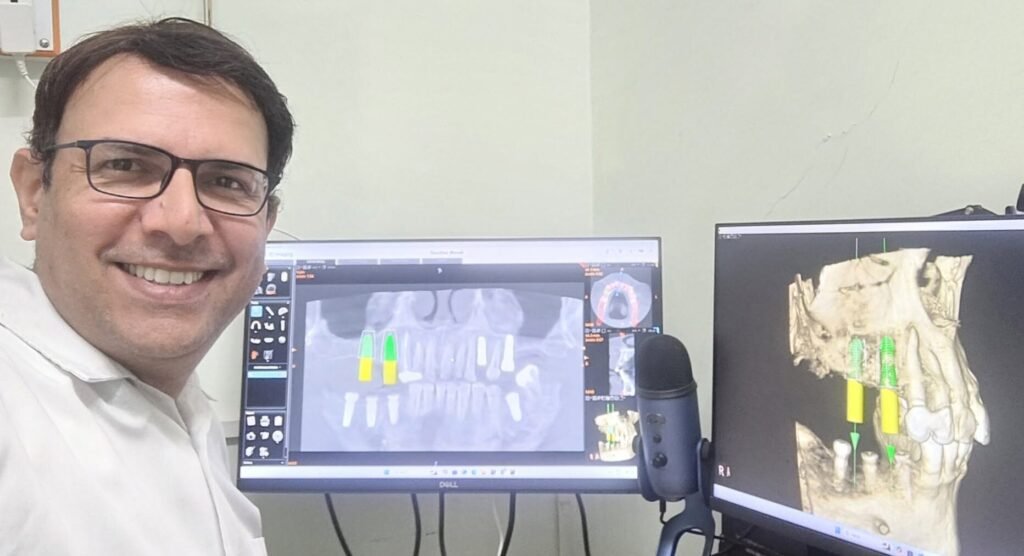
1. Greater Use of 3D CBCT Imaging
Traditional dental X-rays provide useful two-dimensional information.
A CBCT scan provides a three-dimensional view of the jawbone and nearby anatomical structures.
This allows the dentist to assess:
- Available bone height and width.
- Position of important nerves.
- Relationship with the maxillary sinus.
- Bone defects that may require additional treatment.
- Potential implant positions.
A dental implant for busy corporate employees planned using appropriate 3D imaging can help the dentist identify anatomical challenges before surgery.
CBCT doesn’t eliminate surgical risks, but it provides valuable information for treatment planning.
2. Digital Impressions and Intraoral Scanning
Many patients dislike conventional impression materials because they can feel uncomfortable or trigger gagging.
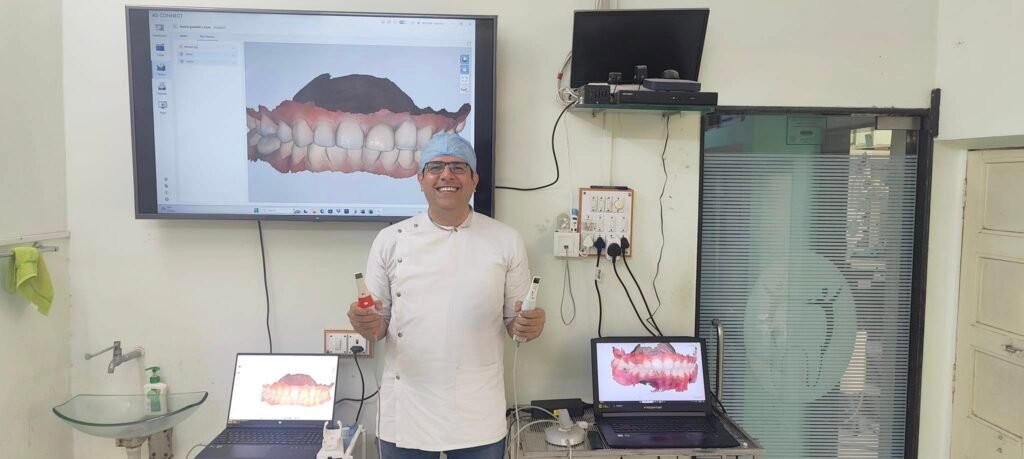
Intraoral scanners offer a digital alternative in suitable cases.
A small scanning device captures the surfaces of teeth and surrounding oral structures, creating a digital model.
This model can help plan the final restoration and communicate with the dental laboratory.
For a dental implant for busy corporate employees, digital impressions may make restorative appointments more comfortable and efficient.
However, some complex implant restorations still require additional verification procedures to ensure accuracy.
3. More Restoration-Driven Implant Planning
Previously, patients often thought of implant treatment primarily as placing a titanium screw inside the jawbone.
Modern treatment planning places greater emphasis on the final tooth.
The dentist considers where the crown should emerge, how it will contact opposing teeth, how it can be cleaned and whether it will look natural.
A dental implant for busy corporate employees should ideally be planned with the final restoration in mind before surgery begins.
This approach helps coordinate surgical and restorative decisions.
4. Better Understanding of Immediate and Early Treatment Protocols
Some patients can receive an implant immediately after tooth extraction.
Others may benefit from waiting for soft tissue or bone healing.
Similarly, selected patients may receive a temporary restoration shortly after implant placement.
A dental implant for busy corporate employees doesn’t automatically mean immediate loading or same-day fixed teeth.
The appropriate timing depends on clinical conditions, primary implant stability and the forces that the restoration will experience.
5. Greater Emphasis on Individual Treatment Schedules
Professionals increasingly want to understand the complete treatment journey before committing.
That includes consultations, imaging, surgery, healing, restoration and maintenance.
A dental implant for busy corporate employees becomes easier to manage when the dentist provides a realistic appointment schedule and explains which stages may require time away from work.
My Top 5 Dental Implant Choices for Busy Corporate Employees in 2027
These five choices represent treatment approaches rather than rankings of commercial implant brands.
The most suitable option depends on the patient’s condition.
1. Single-Tooth Implant With a Digitally Planned Crown
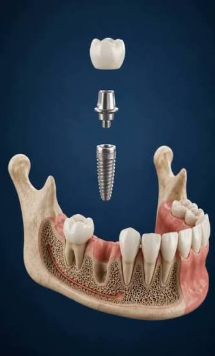
Best for: Professionals who have lost one tooth but have healthy neighboring teeth.
One honest reason to choose it: A single implant can replace a missing tooth without routinely requiring preparation of the adjacent natural teeth.
Suppose a 42-year-old software engineer loses a lower first molar because of a vertical root fracture.
The neighbouring teeth are healthy.
A conventional dental bridge might require preparation of both adjacent teeth, whereas a single implant offers an independent replacement.
For this patient, a dental implant for busy corporate employees may help restore chewing while preserving neighbouring tooth structure.
The treatment generally involves assessment, implant placement, healing and final crown delivery.
The complete process can take several months, depending on bone conditions and the healing protocol.
What to consider: Implant surgery is still a surgical procedure, and maintenance is essential.
2. 3D-Planned Implant Treatment With Digital Impressions
Best for: Professionals who prefer a carefully documented treatment plan and a clear understanding of the procedure.
One honest reason to choose it: Digital planning can help the dentist evaluate implant positioning and coordinate the surgical and restorative stages before treatment.
At Joglekar’s Dental Solutions in Chinchwad, Pune, patients can access in-house 3D CBCT imaging, intraoral scanning and digitally planned implant treatment.
This is one option for patients who prefer to have these diagnostic and planning facilities available at the same clinic.
For someone seeking a dental implant for busy corporate employees, having relevant technology available in-house may simplify coordination between diagnostic and treatment appointments.
However, digital technology doesn’t replace clinical judgment, surgical experience or proper case selection.
The quality of treatment depends on how the dentist interprets the information and uses it.
3. Immediate Implant Placement After Tooth Extraction
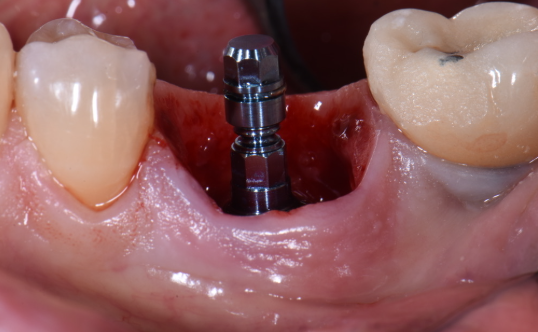
Best for: Selected patients whose damaged tooth requires extraction and whose bone conditions support immediate implant placement.
One honest reason to choose it: In suitable cases, extraction and implant placement can be combined into one surgical appointment.
Consider a 38-year-old manager with a fractured upper premolar that cannot be restored.
If the surrounding bone and soft tissues are favourable, the dentist may consider placing an implant during the extraction appointment.
For this patient, a dental implant for busy corporate employees may reduce the need for a separate implant placement surgery.
However, immediate implant placement isn’t suitable for every extraction socket.
The dentist must assess infection, bone integrity, implant positioning and the ability to achieve sufficient stability.
Importantly, immediate implant placement doesn’t necessarily mean that the patient will receive a permanent crown on the same day.
What to consider: A staged procedure may offer a more appropriate outcome when local conditions are unfavourable.
4. Implant-Supported Fixed Bridge for Multiple Missing Teeth
Best for: Professionals missing two or more adjacent teeth.
One honest reason to choose it: Several missing teeth can sometimes be replaced using fewer implants than the number of teeth being restored.
Imagine a 50-year-old business executive missing three lower posterior teeth.
Depending on the available bone and bite forces, the dentist may recommend an implant-supported fixed bridge.
For someone considering a dental implant for busy corporate employees, this approach may provide a fixed replacement without requiring a separate implant for every missing tooth.
The number and position of implants depend on the span of the bridge, available bone, occlusal loading and prosthetic design.
What to consider: Fixed implant bridges require careful cleaning around the supporting implants and beneath the restoration.
5. Full-Arch Implant-Supported Fixed Teeth
Best for: Adults with many missing or non-restorable teeth, or patients struggling with unstable complete dentures.
One honest reason to choose it: A full-arch implant-supported restoration can provide fixed teeth for patients who find removable dentures uncomfortable or difficult to manage.
For example, a 65-year-old retired executive may have worn a loose lower denture for years.
Eating certain foods may be uncomfortable, and the denture may move during conversation.
After comprehensive evaluation, a full-arch implant-supported restoration may be considered.
For such patients, a dental implant for busy corporate employees, including those approaching retirement, can be part of a broader plan to restore chewing function and oral comfort.
All-on-4 and All-on-6 are commonly discussed approaches, but the correct number of implants depends on anatomy, bone quality, prosthetic design and individual risk factors.
What to consider: Full-arch treatment is more complex than replacing one tooth. It involves substantial planning, financial commitment, hygiene requirements and long-term maintenance.
How to Choose the Right Dental Implant When You Have a Busy Work Schedule
Selecting the right dental implant for busy corporate employees starts with asking the right questions.
The most expensive implant isn’t necessarily the best choice.
Likewise, the shortest treatment schedule isn’t always the safest.
1. Ask Whether the Dentist Recommends a Complete Examination
Before recommending an implant, the dentist should assess the entire mouth.
This includes:
- Remaining teeth.
- Gum and periodontal health.
- Bite relationships.
- Available bone.
- Oral hygiene.
- Medical conditions.
- Habits such as smoking or teeth grinding.
A dental implant for busy corporate employees should be part of an overall oral health plan rather than an isolated procedure.
For example, placing an implant while leaving active gum disease untreated may compromise the long-term outcome.
2. Understand the Role of CBCT and Digital Planning
Ask your dentist how implant positioning will be planned.
Three-dimensional imaging is recommended for presurgical implant planning because it helps assess bone volume and important anatomical structures.
A dental implant for busy corporate employees may benefit from digital planning, especially when anatomical conditions are complex or multiple implants are required.
However, CBCT imaging should be used appropriately, with attention to radiation exposure and clinical need.
3. Ask How Many Appointments Are Required
This is especially relevant for patients who travel frequently or work long hours.
The dentist should explain which appointments are necessary and which stages can be coordinated.
For a dental implant for busy corporate employees, the appointment schedule might include:
- Initial consultation and clinical examination.
- Diagnostic imaging and treatment planning.
- Implant placement surgery.
- Postoperative assessment when indicated.
- Healing and restoration appointments.
- Final crown or bridge delivery.
- Periodic maintenance visits.
Some appointments may be combined, while others cannot safely be avoided.
4. Discuss Recovery Before Scheduling Surgery
Many patients can resume routine desk work relatively soon after straightforward implant surgery.
However, discomfort, swelling and fatigue vary.
For a dental implant for busy corporate employees, it’s sensible to avoid scheduling surgery immediately before an important presentation, overseas journey or demanding work event.
Complex procedures, bone grafting and full-arch surgery may require more recovery time.
Follow your dentist’s individual postoperative instructions.
5. Compare Complete Treatment Costs
When evaluating a dental implant for busy corporate employees, don’t compare only the price of the implant fixture.
Ask for a written estimate that clarifies whether the following are included:
- Consultation and diagnostic imaging.
- Implant fixture.
- Surgical procedure.
- Abutment.
- Final crown or bridge.
- Bone grafting, if required.
- Temporary restoration, if required.
- Follow-up and maintenance appointments.
Two treatment estimates may appear very different because they include different procedures or restorative components.
6. Ask About the Implant System
A dental implant is a medical device that must function inside the body for many years.
Ask which implant system is being recommended, whether compatible restorative components are available and how future maintenance will be managed.
The ideal dental implant for busy corporate employees should be supported by an appropriate treatment plan and reliable long-term restorative support.
A well-established implant brand may be beneficial, but brand selection alone doesn’t determine success.
7. Discuss Long-Term Maintenance
Implants cannot develop tooth decay, but the surrounding tissues can develop inflammation and disease.
Patients need appropriate brushing, interdental cleaning and periodic professional assessment.
A dental implant for busy corporate employees should therefore be viewed as a long-term commitment rather than a one-time procedure.
Busy schedules shouldn’t become a reason to skip maintenance appointments.
Dental Implants vs Dental Bridges: Which Is Better for Working Professionals?
This is one of the most common decisions when replacing a missing tooth.
Both options can be successful when properly selected.
| Factor | Dental implant | Conventional tooth-supported bridge |
|---|---|---|
| Neighbouring teeth | Usually doesn’t require preparation | Often requires preparation |
| Surgery | Required | Usually not required |
| Treatment time | Often several months | Usually shorter |
| Bone assessment | Important | Depends on clinical situation |
| Cleaning | Requires implant-specific maintenance | Requires cleaning beneath the bridge |
| Suitability | Depends on bone and general health | Depends on supporting teeth |
For a professional with healthy adjacent teeth, a dental implant for busy corporate employees may offer the advantage of an independent replacement.
However, a bridge may be preferable when neighbouring teeth already require crowns, implant surgery is unsuitable or the patient prefers a nonsurgical option.
Neither treatment should be chosen solely on convenience.
Are Same-Day Dental Implants Really Better?
The phrase “teeth in a day” is attractive, especially to professionals who cannot easily take time away from work.
But it’s important to understand what the term means.
Immediate implant placement refers to placing an implant at the time of extraction.
Immediate restoration refers to attaching a restoration soon after placement, while immediate loading involves applying functional forces within a defined early period.
These aren’t interchangeable concepts.
A dental implant for busy corporate employees may sometimes be restored quickly, but only when the clinical conditions support the chosen protocol.
Implant stability, bone condition, soft tissue health and occlusal forces must all be considered.
In some cases, allowing additional healing time is the better choice.
How Long Does Dental Implant Treatment Take?
There is no single timeline that applies to every patient.
For a straightforward case, the implant may be placed during one surgical appointment, followed by a healing period before the final crown.
Other cases require extraction, socket healing, bone grafting or additional procedures.
A dental implant for busy corporate employees should be planned around biological healing rather than an arbitrary deadline.
| Treatment stage | What happens |
|---|---|
| Consultation | Examination and discussion of options |
| Planning | Imaging, digital records and treatment design |
| Surgery | Implant placement, with grafting if required |
| Healing | Bone and surrounding tissues recover |
| Restoration | Final crown, bridge or prosthesis is fitted |
| Maintenance | Periodic reviews and professional care |
Treatment timelines can range from a few months to considerably longer in complex cases.
A detailed plan should explain the expected sequence before treatment begins.
Can You Return to Office Work After Implant Surgery?
For many patients undergoing uncomplicated implant placement, a return to routine desk work within one or two days may be possible.
But recovery varies.
A dental implant for busy corporate employees should be scheduled with realistic expectations about postoperative discomfort, swelling and activity restrictions.
If your work involves frequent speaking, public presentations or long-distance travel, discuss these commitments with your dentist before selecting the surgery date.
It’s usually better to allow a little flexibility than to promise an unrealistic recovery schedule.
What About Dental Implants for Professionals Over 50?
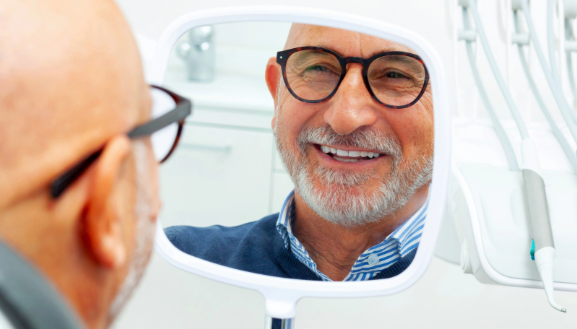
Age alone doesn’t determine whether someone is suitable for implant treatment.
Many adults in their 50s, 60s and beyond can be candidates for implants.
The more important considerations include general health, medications, bone availability, periodontal condition and ability to maintain oral hygiene.
A dental implant for busy corporate employees over 50 should be evaluated with particular attention to existing dental restorations, missing teeth, bite changes and long-term treatment needs.
For some patients, replacing one tooth is sufficient.
For others, a comprehensive rehabilitation plan may provide a more coordinated solution.
Can Dental Implants Improve Chewing and Nutrition?
Missing teeth can make chewing difficult, especially when several posterior teeth are absent.
Some patients begin avoiding harder foods and limit their diet to softer options.
A dental implant for busy corporate employees may help restore chewing function by supporting a fixed replacement.
Improved chewing comfort can make it easier to enjoy a wider variety of foods.
However, dental implants don’t directly guarantee better digestion or nutritional health.
Those outcomes depend on many factors, including food choices, general health and digestive function.
The realistic goal is to restore comfortable, effective oral function.
Why Complete Dental Planning Matters More Than Replacing One Tooth
A missing tooth may be only one part of a larger dental problem.
Some patients also have worn teeth, failing crowns, gum disease, missing posterior support or changes in their bite.
A dental implant for busy corporate employees should therefore be considered in the context of the entire mouth.
A comprehensive examination may reveal that other teeth need treatment before implant placement.
In some situations, root canal treatment, crowns or periodontal therapy may help preserve natural teeth.
The objective should be to maintain a healthy, functional dentition rather than replace teeth unnecessarily.
Five Questions to Ask Before Choosing an Implant Dentist in PCMC
Before deciding where to receive a dental implant for busy corporate employees, ask:
- What treatment options are available for my specific condition?
- How will you assess bone availability and plan implant positioning?
- What are the expected treatment stages and recovery periods?
- What is included in the total treatment estimate?
- How will my implants and restorations be maintained over time?
A good consultation should leave you understanding both the advantages and limitations of treatment.
You should also feel comfortable asking about the dentist’s experience with cases similar to yours.
Frequently Asked Questions
1. What is the best dental implant for a busy corporate employee in 2027?
The best dental implant for busy corporate employees depends on the number of missing teeth, available bone, medical history, bite and aesthetic needs.
A digitally planned single implant may suit someone missing one tooth, while a fixed implant bridge or full-arch restoration may be appropriate for more extensive tooth loss.
2. Is dental implant surgery painful?
Implant placement is generally performed under local anaesthesia.
Patients may experience pressure or vibration during surgery, but significant pain shouldn’t be expected while the area is adequately anaesthetised.
Some postoperative discomfort, swelling or bruising is possible.
3. Can I get dental implants if I have diabetes?
Many patients with well-controlled diabetes can be considered for dental implants after appropriate medical and dental assessment.
Poorly controlled diabetes may increase complications and affect healing.
The dentist should review medical history and relevant investigations before treatment.
4. Are dental implants better than removable dentures?
Fixed implant restorations may offer greater stability and chewing comfort for suitable patients.
However, removable dentures remain an appropriate treatment for some individuals.
The choice depends on clinical conditions, preferences, maintenance ability and budget.
5. Do dental implants last forever?
Dental implants can function for many years, but no implant should be promised to last forever.
Long-term outcomes depend on patient health, oral hygiene, implant positioning, restorative design, bite forces and maintenance.
6. Is 3D-guided implant treatment more expensive?
Digital planning may involve additional diagnostic or planning costs.
However, the total cost depends on the clinical complexity, implant system, restoration and any additional procedures.
Ask for a complete treatment estimate rather than comparing isolated charges.
7. Can I travel after dental implant surgery?
Travel may be possible after uncomplicated treatment, but timing should be discussed with the treating dentist.
Long journeys immediately after surgery can make it harder to manage unexpected discomfort or complications.
8. How do I find a suitable implant dentist in Chinchwad or PCMC?
Look for a dentist who provides a comprehensive examination, explains available options, discusses risks and costs, and has an appropriate plan for long-term follow-up.
The availability of digital imaging and restorative planning can be useful, but technology should complement clinical expertise.
Final Thoughts: The Right Implant Should Fit Your Health, Not Just Your Calendar
Choosing a dental implant for busy corporate employees in 2027 is about balancing convenience with sound clinical decisions.
Modern CBCT imaging, digital impressions and restorative planning can help patients understand treatment and organize appointments.
But faster treatment isn’t always better treatment.
The best decision is one that considers your oral health, medical condition, professional commitments, long-term function and personal expectations.
A carefully selected implant restoration can help you return to comfortable chewing, natural-looking teeth and confidence in everyday life.
If you’re living or working in Chinchwad, Pimpri, Akurdi, Wakad or the surrounding PCMC area, consider arranging a comprehensive dental consultation to understand which treatment options may be appropriate for you, and be sure to contact Joglekar’s Dental Solutions.
A healthy smile should support your professional life, not become another source of stress.
One Response